Showing posts with label planning. Show all posts

25 August 2012

testing


With less than a month to go before the residency exhibition things are coming together.  I've spent today testing out how things look in the different spaces in the lighthouse.  As an exhibition space it is pretty challenging: there are low light levels in most rooms; floors and surfaces are dirty; and there are a lot of steps!  By exhibiting work at the top of the building (where the light is better) you are expecting visitors to invest in the effort required to walk up all those steps.  Hopefully the promise of the view from the top is enough to encourage people to make that investment!  Lower down, where it is gloomy, even on a bright day, there is a risk that work will just not have an impact at all.  There is a lot to consider in trying to create an exhibition that will be successful for the viewer.

I was also interviewed today for BBC Look North, which was fun.  We recorded sequences on the top of the dunes, in the lighthouse and up on the balcony at the top.  The feature should go out sometime next week in the eastern part of the region.  The weather was good to us, with bright sunshine while the crew were there.  


Later things got very hazy and strange light joined rumbles of thunder before some rain.


17 July 2012

marks on silk


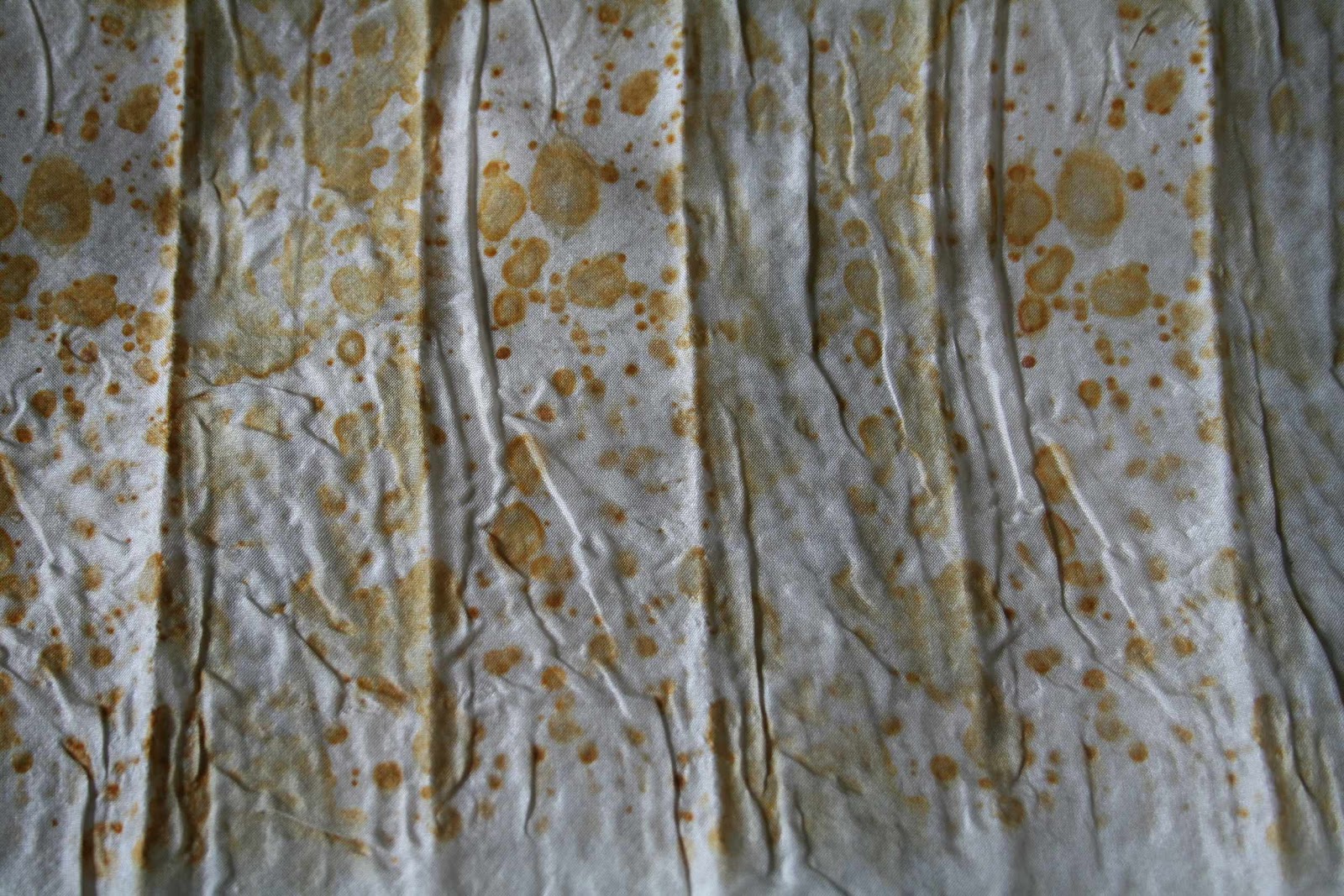
As well as the fabric wrappings that I left at Spurn to gather marks from the groynes, I have also made bundles at home with rusty things collected on the beach.  These are all unwrapped now.  The silk practically glows with reflected light and the prints are a curious mix of subtle and strong.


I am planning two large textile pieces for my exhibition, as well as a series of prints on paper.  In terms of a space for showing art the lighthouse is pretty challenging: it is large (!) and there are generally low light levels.  This means that the subtle shades and natural tones that I am drawn to working in won't have much of an impact.  So I must bear this in mind when preparing work to go in the various rooms.  The one space that does have good natural light is the lamp room and this is flooded with it, even on a cloudy day.  I am going to make the most of that and am planning one of my large pieces for this space, where the viewer will be able to see the work very close and in good light.

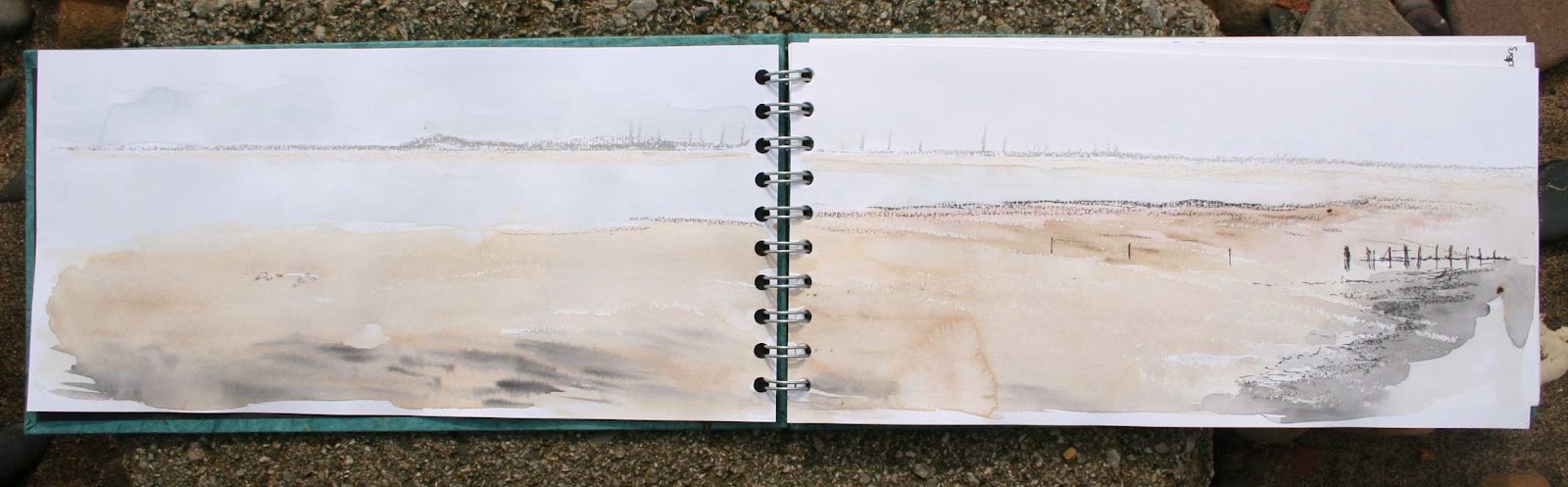
I will be using the silk that I've dyed using rust and tea and making a kind of art quilt.  I'm going to start putting this together and working on it in earnest next week, when I'm at Farfield Mill.  The painted sketches I did last weekend will help guide me when putting this together and I'm really looking forward to having the space to spread my fabrics out and start fitting them together.

27 May 2012

sorting textures


I've been sorting through some of the textures and ideas I collected at Spurn last weekend.  One of the main things that strikes me about the place are the bands of texture and line: linear arrangements and almost always horizontal. 


As the tide comes up and goes down there is this constant change of the bands: 

patterns in the sand, 
the strips of salt marsh on the estuary side, 
never-ending sequence of waves rolling in on the seaward side, 
lines of groynes.

As a way of focusing myself I sorted the images that I'd had printed into three groups of textures:
ripples and wave patterns in the sand;


the waves themselves and the marks left when the water sorts and drops the material it is moving;

  
bold textures of the rusty, weathered groynes, the saltmarsh and other debris on the beach.


15 May 2012

reading


I've done quite a bit of reading both as part of my planning for this project and since I started.  I have a little pile of relevant titles and have really enjoyed either re-visiting books I've read before or finding new ones.

I can't get enough of the recent and current writing on the natural world.  There is a particular genre here that includes Richard Mabey, Robert MacFarlane, Roger Deakin, Mark Cocker, Kathleen Jamie... they all have in common an intense level of observation of the world around them and are able to convey the wonder they have for it in a gripping and beautiful way.  I find their writing very inspiring.

As I'm reading I mark passages that are particularly relevant...


The cleavages between the sand dunes, where the wind and waves had driven it, were choked with plastic... They had their own fascination, the shampoo and milk cartons, the toilet cleaner bottles we could turn over with our feet.  Though the colours were faded and the labels long gone, we knew their shapes, had seen them ranked in supermarkets and hardware stores.  Brushes, masking tape, training shoes, orange polypropylene net...

(p59, Findings by Kathleen Jamie)


My habit of gathering stones and other talismans was a family one.  My parents were collectors.  Shelves and window-sills in my house were covered in shells, pebbles, twists of driftwood from rives and sea.  For as long as I could remember, we had picked things up as we walked.  Humdrum, everyday rites, practised by millions of people…. Now, though, collecting offered a way both to remember and to join up my wild places…. The objects seemed to hold my landscapes together, without binding them too tightly.

(p87-88, The Wild Places by Robert Macfarlane)


Our coast is being altered by the sea at every tide, and every storm, and nowhere more than here on the east coast.

(p76, Waterlog by Roger Deakin)  


I was recommended Polly Binns' Vision and Process in Textile Art.  A Personal Response to a Particular Landscape Expressed Through Textile Art.  This is her Phd thesis.  It has been a very valuable read for me and very relevant to my engagement with coastal landscape.  Although her engagement with the North Norfolk coast was all around her every day so she could enjoy the total immersion that I am dipping in and out of with Spurn.

The People Along the Sand by Jan Crowther is a history of Spurn and the people that have lived there since 1800 and I'm finding it really quite gripping!  It is so incredible that people have lived and worked on this inhospitable strip of land, often at the mercy of the sea and for a long time before there were roads and cars.  This really brings home the loss of land to the sea and describes the communities here having to shift and re-adjust when erosion gets the better of their buildings. 

23 April 2012

Friday 20th April

I drove over to Spurn last Friday, a typical April day with dramatic grey clouds, bright bits in between and the threat of a heavy shower at any time.  After Hull the landscape is very like that of North Lincolnshire, where I grew up: flat fields, ditches with stands of reed, fields of yellow oil seed rape starting to dominate with their loud yellow.  This all feels familiar and relatively stable (apart from the changing weather).  

Once on the peninsular things are in constant flux: tides, weather, exposure, light levels, visibility.  The view is constantly changing because of all these things, but there is always big sky and a wide horizon all around.


The view across the Humber forms a kind of arc of land, as if looking across a lake, with the north bank merging in the distance to the south bank of the estuary.  Across the water are Grimsby, Cleethorpes and the Humber bank industries, which become a string of twinkling lights at night.  Ships come and go all the time, up and down the estuary and out in the North Sea. 

The curve of the peninsular is very apparent at the northern end of it, so rather than looking down the spine of the spit you look across water or sand to the point and the lighthouse in the distance (it's about 3.5 miles long).

I have almost 2 hours walking on a small section of the western shore.  There is so much to take my attention and I don't know quite what to settle on so I decide to draw whatever catches my eye, try things out and not worry about the results.  I have to find a way into things, find a pattern of recording that is appropriate and fits with the ever-changing conditions.  The elements govern everything here.  Plans have to be flexible.


I find that about 2 hours outside in one go is enough, less if the weather is unkind.  To be able to retreat to the car or the Bird Observatory for a warm drink, some note taking and then a change of location or direction is necessary.  
  
 
I got really absorbed in drawing sand patterns; sketched bits and pieces on the tide line; made rubbings of a wooden groyne; picked up small items of washed up rubbish that could be used for printing; noted where there were pockets of rusty metal (dyeing potential), drift wood and cockle shells; so much potential everywhere.  Lots of thinking, planning and note taking.  My first couple of visits must be about absorbing the place, understanding how to work here and finding that potential.  Only after this period of discovery can I make some decisions about what I want to concentrate on and make the focus of my work here.