Showing posts with label drawing. Show all posts

29 June 2012

sun and wind


The sun is shining on Spurn today and the air feels warm.  There is also a strong wind from the south, blowing up from the point.  A walk on the beach in sandals means windswept hair and glowing skin but this is the first time I've been here and dared to walk without a waterproof jacket or socks!  Bright sunshine and a keen wind make for animated clouds, rushing over, rapidly changing colours and tones of the water as they pass. 

The air is incredibly clear and views across the Humber to the south bank provide detail I've net seen before. The sunlight reflecting off the water is stunning; both over the sea/estuary and on wet sand:


As ever, it is the detail of the bands of texture on the beach that fascinate me; the way material is sorted and arranged by the water and, in places, separated out in a very marked way.


I'm looking forward to inspecting some of the fabrics I left here last time and finding out what marks have been left on them by their time here.  That comes tomorrow...

23 June 2012

ripples


The patterns in the sand left by water as well as the patterns of the water itself have really grabbed me and given a focus to my sketchbook work.  These both present their own challenges for drawing: the water is constantly moving and, although the sand is static when I can see it, the ripples are part of such expansive areas.

On my last visit I experimented with a borrowed camera and took some little movie sequences of both.  There was a keen wind that kept the surface of the water lying on the beach moving.


I've never tried adding movies to a blog post before and I suspect they might be too large so the other ones are here, here and here. The last and longest one was taken walking across the beach looking at the ripple marks in the sand as I walked, approaching the sea.  It wobbles a bit in places but I think it shows the scale of things well, from the detail of small ripples to the expanse of water and sand stretching away.

I started to experiment with how I can create textures based on the ripples for print.  I'm developing drawings with pen into ones using stitch:


9 June 2012

white horses


The wind is still blowing fiercely from the west but the rain has gone and there is bright blue sky between fast moving clouds (for now...).  The sun reflects off the sea turning it to liquid silver.  The waves on the Humber side (usually the calmer side of the spit) are relentless and the estuary is full of dancing white horses.  There are all sorts of greens mixed in with the browns of the water, all with constantly moving cloud shadows.  


Nothing stays the same here for any length of time.  It is difficult to know which direction to look in, what to focus on: there is so much going on.

The constant change means difficulties for drawing.  How can I capture this movement and change?

30 May 2012

multiple horizons

I've been developing some of the experiments I did in a small sketch book when I was last at Spurn.  I'm working on a larger scale and using a variety of different media to explore some of the horizontal views.


27 May 2012

sorting textures


I've been sorting through some of the textures and ideas I collected at Spurn last weekend.  One of the main things that strikes me about the place are the bands of texture and line: linear arrangements and almost always horizontal. 


As the tide comes up and goes down there is this constant change of the bands: 

patterns in the sand, 
the strips of salt marsh on the estuary side, 
never-ending sequence of waves rolling in on the seaward side, 
lines of groynes.

As a way of focusing myself I sorted the images that I'd had printed into three groups of textures:
ripples and wave patterns in the sand;


the waves themselves and the marks left when the water sorts and drops the material it is moving;

  
bold textures of the rusty, weathered groynes, the saltmarsh and other debris on the beach.


20 May 2012

collecting textures

Another grey day and lots of layers are needed to keep out the relentless wind.  But at least it's dry. 


The space I set up yesterday on the second floor of the lighthouse (in front of the big window in the middle) has been really useful as a place to spread things out and do some experiments in wet media.  The room is painted black, as is the room below.  I'm not sure what the significance of the darkness is.  It has a large window which gives enough light to work by.


I decided on Friday's drive over here that this trip must be about collecting textures.  So that is what I've tried to concentrate on.  I've drawn a lot, using pens and charcoal when I'm outside and started to play with making marks from some rusty metal found on the beach.  I tried working on a larger scale yesterday but nothing seemed to work so I've gone back to working on small sketchbook pages, removed carefully from the book to work on so that I can put them back together once things have dried.


25 April 2012

Saturday 21st April

I wake to a blanket of steady drizzle laid over the peninsular: grey, cold, damp.

After breakfast I sit on the bench opposite the Bird Observatory for almost an hour.  The tide is going down, which on this flat, shallow estuary side moves quickly, revealing sand banks, mud flats and the strip of salt marsh.  The textures and patterns are fascinating.


Birds sit in groups, flying every now and then to a new spot along the sand.  I am told by a passing birder that what I'm looking at are godwits, curlew and plovers.  They're too far away for me to be able to see enough detail to identify them.  I'm embarrassed by my lack of knowledge.

Instead I concentrate on the patterns of mud and plant life in the band along the mud flat edge and draw the strip of texture where land and water meet.  Raindrops help the variety of marks from my pen.  As the rain becomes more persistant I use water soluble pastels to capture colour.  The rain is a good partner in this excercise but my hands get cold eventually.


I move in the car down to Chalk Bank Hide, where the wind still whistles in but I'm out of the rain.


The hide, although drafty, is a good place to draw as there is a ledge to rest my book on and and bench to rest myself on. I can wait for pages to dry while I work on other things.  I do need to find a system of working with wet media here.  I'm hoping access to the lighthouse will help.  I enjoy the plaintive sounds of the curlew.

The rain suddenly lifts and the sun comes out.  I walk between the two Hides on this stretch looking at the brown tailed moth cocoons.  They are strange and slightly sinister, this feeling increased by the knowledge that the hairs from the caterpillars can cause severe irritation.


After lunch I walk on the Humber side again, by the exposed salt marsh.  


A heavy shower starts and drawing quickly becomes impossible.  I get absolutely soaked and then it turns to hail.  I turn and walk back the way I came, and when the shower passes I cross onto the seaward side of the peninsular where the wind is.  Because the tide is down there is a large expanse of concrete blocks exposed, sea defences that I didn't see yesterday when the tide was higher. 


Along with the wooden groynes these man-made structures form dominating marks along the beach.  As well as these purposefully placed items there is a constant selection of washed up plastic on the beach.  This unavoidable rubbish is fascinating and depressing in equal measures.  Thunder rolls in the distance.  The waves thunder too on this seaward side.  Spectacularly large showers move on the horizon.  I hope to dry off in the wind before the next one reaches me.    

23 April 2012

Friday 20th April

I drove over to Spurn last Friday, a typical April day with dramatic grey clouds, bright bits in between and the threat of a heavy shower at any time.  After Hull the landscape is very like that of North Lincolnshire, where I grew up: flat fields, ditches with stands of reed, fields of yellow oil seed rape starting to dominate with their loud yellow.  This all feels familiar and relatively stable (apart from the changing weather).  
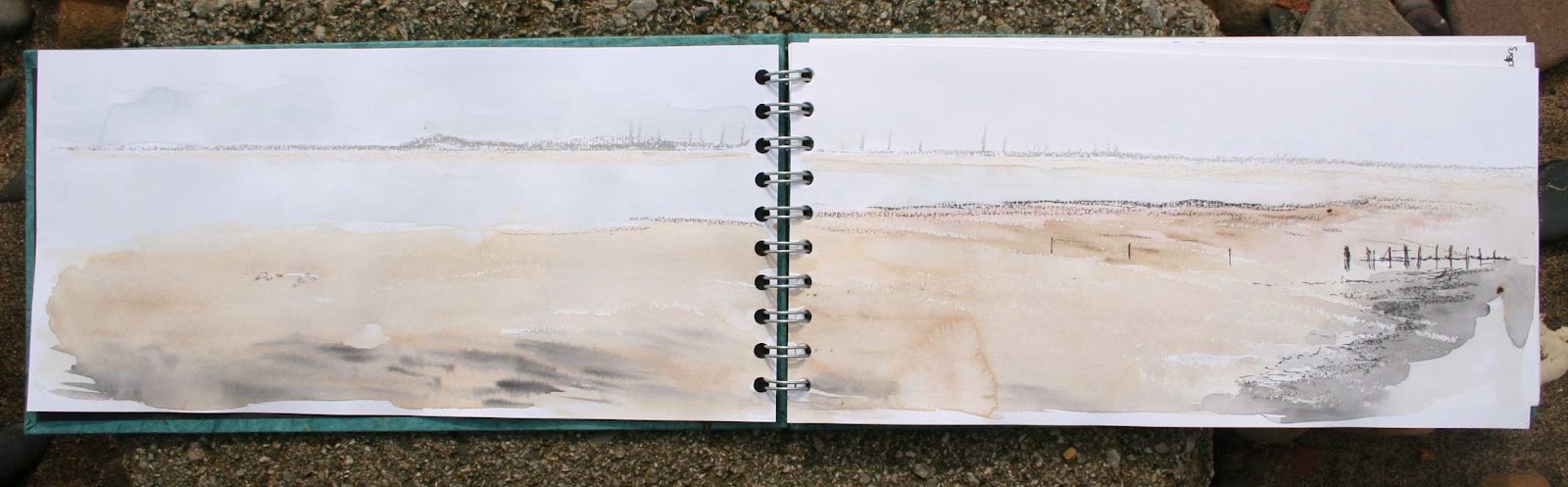
Once on the peninsular things are in constant flux: tides, weather, exposure, light levels, visibility.  The view is constantly changing because of all these things, but there is always big sky and a wide horizon all around.


The view across the Humber forms a kind of arc of land, as if looking across a lake, with the north bank merging in the distance to the south bank of the estuary.  Across the water are Grimsby, Cleethorpes and the Humber bank industries, which become a string of twinkling lights at night.  Ships come and go all the time, up and down the estuary and out in the North Sea. 

The curve of the peninsular is very apparent at the northern end of it, so rather than looking down the spine of the spit you look across water or sand to the point and the lighthouse in the distance (it's about 3.5 miles long).

I have almost 2 hours walking on a small section of the western shore.  There is so much to take my attention and I don't know quite what to settle on so I decide to draw whatever catches my eye, try things out and not worry about the results.  I have to find a way into things, find a pattern of recording that is appropriate and fits with the ever-changing conditions.  The elements govern everything here.  Plans have to be flexible.


I find that about 2 hours outside in one go is enough, less if the weather is unkind.  To be able to retreat to the car or the Bird Observatory for a warm drink, some note taking and then a change of location or direction is necessary.  
  
 
I got really absorbed in drawing sand patterns; sketched bits and pieces on the tide line; made rubbings of a wooden groyne; picked up small items of washed up rubbish that could be used for printing; noted where there were pockets of rusty metal (dyeing potential), drift wood and cockle shells; so much potential everywhere.  Lots of thinking, planning and note taking.  My first couple of visits must be about absorbing the place, understanding how to work here and finding that potential.  Only after this period of discovery can I make some decisions about what I want to concentrate on and make the focus of my work here.