I'm spending this week at Farfield Mill in Cumbria. I am artist in residence here during that time. Yes I know, surely I can't be 'in residence' in two places at once... But I've brought a bit of Spurn here with me (images, sketches, notes, memories) and I am very much there in spirit. I am using this week to work in a concentrated way on my two big textile pieces, currently called Spurn cloth #1 and Spurn cloth #2... these unromantic titles may change with time but for now they will do.
I have a clean, light space here where I can spread out and work away from the distractions of my home studio. It would be tricky to do this in the lighthouse and while I work here I have people popping in to see what I'm doing so I can tell a different bunch of people about the project.
My first job yesterday, after unpacking my things, was to lay out the roll of felt In using as the base for cloth #1. This is industrial wool felt and will give a strong but flexible base to the piece that is beautiful to stitch into. My roomy studio floor was perfect for laying it out, measuring and cutting it to the size I need. I could then start to arrange my dyed silk on top of it. There then followed a great deal of fiddling, moving, rearranging, considering etc. until I was happy with the arrangement.
I could then begin to pin the pieces in place. This cloth is to hang in the lamp room in the lighthouse, where there is good light and visitors will be able to see the detail of the surface very close. There is a suggestion of a horizon and this work will almost be reflecting back the 360 degree view you get from the top of the lighthouse. But I'm not trying to represent it directly, rather I aim to capture something of the changing tones and marks in sky, sea and sand.
I will be giving an illustrated talk here at Farfield Mill on Friday at 2pm, all about the project.
Showing posts with label marks. Show all posts
24 July 2012
17 July 2012
marks on silk
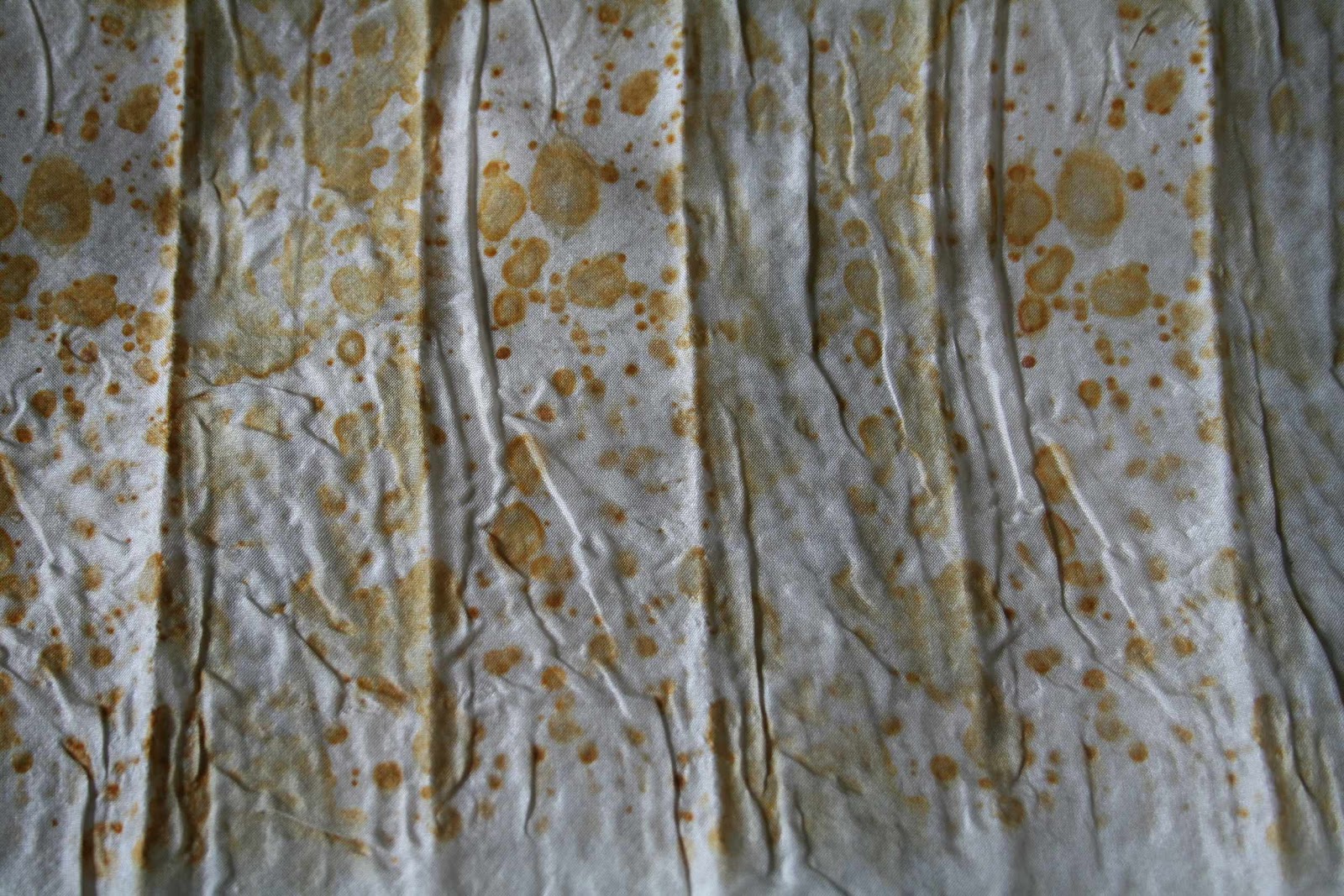
As well as the fabric wrappings that I left at Spurn to gather marks from the groynes, I have also made bundles at home with rusty things collected on the beach. These are all unwrapped now. The silk practically glows with reflected light and the prints are a curious mix of subtle and strong.
I am planning two large textile pieces for my exhibition, as well as a series of prints on paper. In terms of a space for showing art the lighthouse is pretty challenging: it is large (!) and there are generally low light levels. This means that the subtle shades and natural tones that I am drawn to working in won't have much of an impact. So I must bear this in mind when preparing work to go in the various rooms. The one space that does have good natural light is the lamp room and this is flooded with it, even on a cloudy day. I am going to make the most of that and am planning one of my large pieces for this space, where the viewer will be able to see the work very close and in good light.
I will be using the silk that I've dyed using rust and tea and making a kind of art quilt. I'm going to start putting this together and working on it in earnest next week, when I'm at Farfield Mill. The painted sketches I did last weekend will help guide me when putting this together and I'm really looking forward to having the space to spread my fabrics out and start fitting them together.
Labels:
bundles,
eco-dyeing,
exhibition,
Farfield Mill,
lighthouse,
marks,
planning,
print,
residency,
rust
1 July 2012
unwrapping
Low tide was around breakfast time yesterday so the first thing I did when I got down to the point was to inspect the fabric bundles I'd left a few weeks ago. I could only find five of the seven I'd noted down, so two have been lost to the sea. There is a certain ceremony to unwrapping something that has been left like this to develop with hope and expectation. I carefully snip the string and unwind it, then slowly unwrap the fabric itself.
One had to be dug out of a small dune that had formed against the groyne it was attached to.
The ones left further down the beach, which have been submerged with every high tide, twice a day are certainly more worn with deeper, darker marks. Those nearer the top of the beach are still very white with bright orange rust marks, so these must only have been submerged a handful of times.
I took them all inside and up to the lamp room where there is a rail I could drape them over in the sunshine to have a good look.
They looked well in bright sunlight, particularly the silk, whose creases catch the light in much the same way as the ripples on sand and water.
There are grubby marks, bits of sand and seaweed, holes where they've been pounded by the waves. Some bits are rather too much like tie-dye but other parts are really unexpected and beautiful. I spent a good deal of time on this visit forming a clearer vision of the final pieces I'd like to produce. The ideas are still growing, and they will continue to do so with the making, but I have a good deal of material to work with now.
Labels:
bundles,
eco-dyeing,
groynes,
light,
lighthouse,
marks,
rust,
sea
19 June 2012
wrapped up
Having undone the bundle I had left on one of the groyne bolts on my last visit I prepared to leave some more to mature for next time. I'm trying to take marks from Spurn itself, using things that are part of the place. Because Spurn is a Nature Reserve my work has to have no impact at all on the place. This means that I can't pick leaves from the sea buckthorn to dye with or anything else along those lines.
The rusty metal that I am finding both on the groynes and lying around on the beach is part of the make-up of the place. Man-made structures are very much part of Spurn's history and the things that are washed up on the beach are as much part of what Spurn is today as the sand, pebbles, seaweed and plants (whether we like it or not!). If it wasn't for these additions then the spit probably wouldn't be in the form it is now.
If I can use these things to make meaningful marks on paper and cloth, with little use of other materials then I feel I am really taking something from the place, making something of the place without any negative impact.
I'm using the sea water as an agent to help me too. I do find that the addition of tea really helps transfer marks from the rusty metal onto paper and cloth (see here for an explanation) so I am using that to help, even though that isn't something that occurs here - I have found a few old tea bags in amongst the other flotsam and jetsam, so maybe that justifies that one! A mixture of sea water and tea from my flask to wet the fabric before wrapping it will hopefully help get things off to a good start and then they will be submerged twice a day by the North sea.
7 June 2012
anticipation
I'm looking forward to returning to Spurn tomorrow, although the weather is horrid and looks like it is continuing like this for a few days. I'm particlularly looking forward to getting to know the groynes a bit better! These wooden structures for slowing the action of long-shore drift are quite dramatic and seem to feature in just about every photo of Spurn you find on Flickr.
I'm interested in the rusty metal that is often attached to these in various states of decay. Much of my work in recent months has featured rust prints as a basis upon which I've layered other print techniques, as well as stitch. I want to see what kind of marks I can take from the rusty objects at Spurn. On my last visit I left a couple of experiments on site. These have hopefully been developing and maturing and I'm looking forward to seeing what results there are.
I wrapped some metal objects I found on the beach, having first wet my fabric in sea water (the nearest sea fisherman along the beach must have thought I was bonkers; dancing around the edge of the water as the tide was coming in and trying to dodge the waves whilst dipping fabric into them). These I left in the lighthouse.
I also wrapped one of the rusty bolts still attached to a groyne but loose. This should be submerged in sea water every time the tide comes up. Even after one night and one high tide it had obviously started to take on some of the rusty colour:
My worry is that these have either worked loose and been washed away or removed by curious visitors. Although this shouldn't be too unusual a thing to come across given that many of the groynes already have many bits of rope and broken net wound round them by the action of the waves. As long as they remain in place and depending on the resulting marks, I plan to set up some more this weekend.
25 April 2012
Saturday 21st April
I wake to a blanket of steady drizzle laid over the peninsular: grey, cold, damp.
Birds sit in groups, flying every now and then to a new spot along the sand. I am told by a passing birder that what I'm looking at are godwits, curlew and plovers. They're too far away for me to be able to see enough detail to identify them. I'm embarrassed by my lack of knowledge.
Instead I concentrate on the patterns of mud and plant life in the band along the mud flat edge and draw the strip of texture where land and water meet. Raindrops help the variety of marks from my pen. As the rain becomes more persistant I use water soluble pastels to capture colour. The rain is a good partner in this excercise but my hands get cold eventually.
I move in the car down to Chalk Bank Hide, where the wind still whistles in but I'm out of the rain.
The hide, although drafty, is a good place to draw as there is a ledge to rest my book on and and bench to rest myself on. I can wait for pages to dry while I work on other things. I do need to find a system of working with wet media here. I'm hoping access to the lighthouse will help. I enjoy the plaintive sounds of the curlew.
The rain suddenly lifts and the sun comes out. I walk between the two Hides on this stretch looking at the brown tailed moth cocoons. They are strange and slightly sinister, this feeling increased by the knowledge that the hairs from the caterpillars can cause severe irritation.
After lunch I walk on the Humber side again, by the exposed salt marsh.
A heavy shower starts and drawing quickly becomes impossible. I get absolutely soaked and then it turns to hail. I turn and walk back the way I came, and when the shower passes I cross onto the seaward side of the peninsular where the wind is. Because the tide is down there is a large expanse of concrete blocks exposed, sea defences that I didn't see yesterday when the tide was higher.
Along with the wooden groynes these man-made structures form dominating marks along the beach. As well as these purposefully placed items there is a constant selection of washed up plastic on the beach. This unavoidable rubbish is fascinating and depressing in equal measures. Thunder rolls in the distance. The waves thunder too on this seaward side. Spectacularly large showers move on the horizon. I hope to dry off in the wind before the next one reaches me.
Subscribe to:
Posts (Atom)